








Fibre is something we all use but rarely see. Here’s a simple guide to what it is, how the market works and where Fern Trading Limited’s fibre businesses fit in.
As an investor in the Octopus Inheritance Tax Service (OITS), you currently hold shares in a company called Fern Trading Limited (Fern). Fern owns businesses operating in renewable energy, real estate and fibre. Understanding a few basics about fibre helps explain what those businesses actually do.
What is fibre?
Every time you join a video call, stream a film or send a photo, data has to travel between your device and the wider internet. Fibre-optic cables carry that data using pulses of light. They can move large amounts of data quickly and reliably, which is why full fibre is gradually replacing the copper lines that have carried phone calls and broadband for decades.
For most of us, the fibre network is invisible. We choose a broadband provider, plug in a router and get online. Behind that connection are physical networks and the businesses that build, own and operate them.
Why fibre matters
Fern first invested in fibre in 2019, when full fibre was available to only around 6%1 of UK premises. As more of everyday life moved online, there was a growing need for faster, more reliable connections and more fibre infrastructure needed to be built.
A lot has changed since then. By July 2025, full fibre was available to 78% of UK residential premises. But availability is not the same as use: at that point, 42% of homes that could get full fibre had taken up a connection2. So, while much more of the network has now been built, there is still room and the need for more homes and businesses to move from older connections onto full fibre.
Not every fibre connection is the same
Think of a fibre network as a road. Residential broadband, the broadband most of us use at home, is like a shared road: lots of homes and smaller businesses use the same local network. For everyday activities such as streaming, video calls and browsing, that works well.
Enterprise fibre is like having your own lane. Larger organisations that move a lot of data, and need greater capacity and reliability, can use dedicated connectivity rather than sharing capacity in the same way.
Residential and enterprise describe different types of fibre connection and the customer needs they serve. There is another important distinction: how those connections are sold to the customer.
The company you pay may not own the cables
When you buy broadband, it is natural to assume the company you pay owns the fibre running to your home or business. Often, it does not.
There are two different roles behind a broadband service:
- Owning the network. Building, owning and running the physical fibre infrastructure.
- Providing the service. Selling broadband or connectivity and looking after the customer.
Sometimes one company performs both roles. In other cases, the company selling you the service buys access to a network owned by somebody else.
What does wholesale fibre mean?
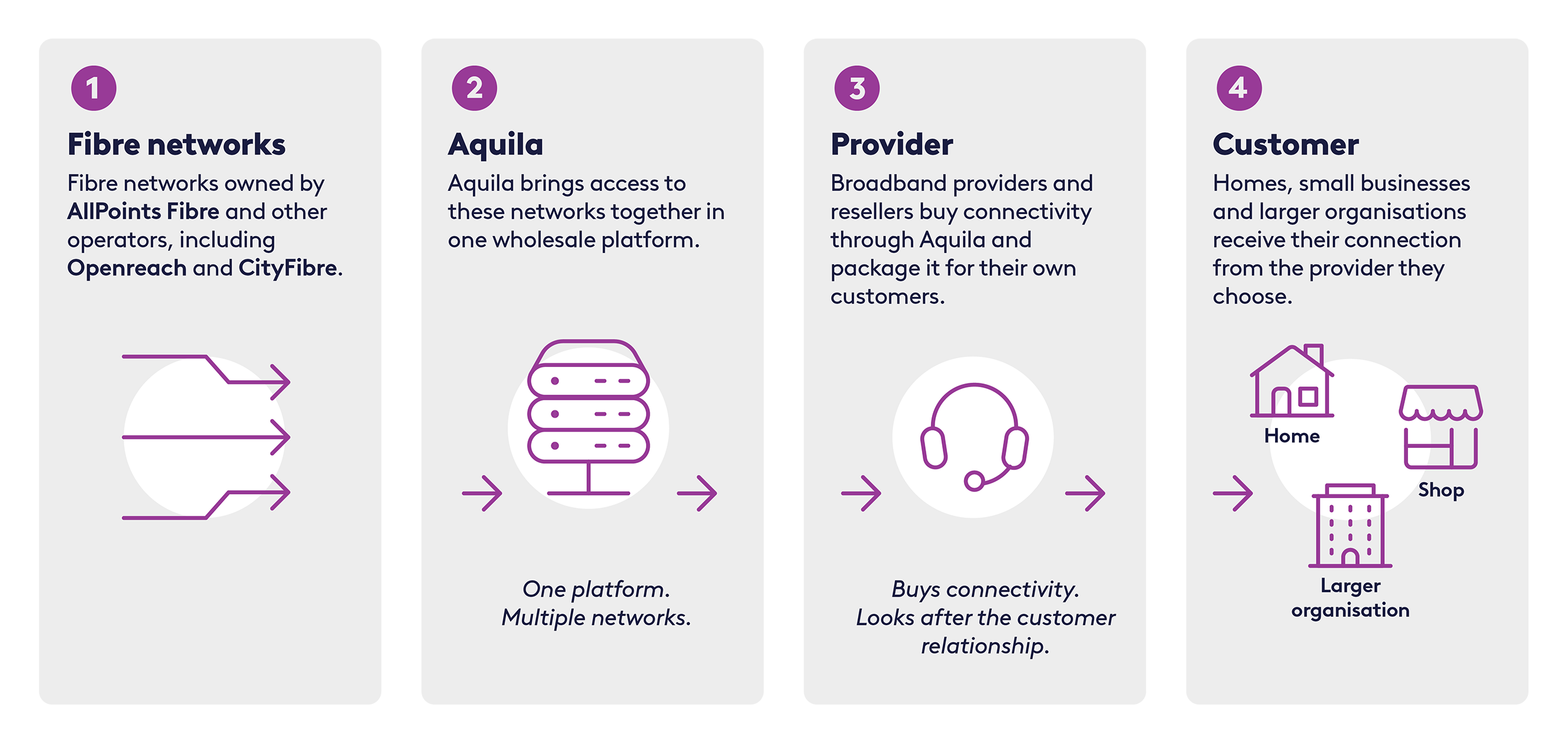
Building fibre networks is expensive, so broadband providers do not all build their own. Instead, they can buy access to networks that already exist and use them to serve their customers. This is wholesale fibre.
Behind the scenes, your broadband provider may be using another company’s network to deliver your connection. Wholesale refers to the relationship between the network owner and the broadband provider, whether the end customer is a home or business.
Risks to bear in mind
OITS is a high-risk, long-term investment. Your capital is at risk and you may get back less than you invest. The companies OITS invests in are unquoted and their shares can be difficult to sell, so access to your investment is not guaranteed.
So where do Fern’s fibre businesses fit?
Fern’s two fibre businesses use these models differently. Vorboss, held in Fern A shares, owns its Central London network and serves business and public-sector customers directly. AllPoints Fibre Networks (APFN), held within Fern B shares, owns local fibre networks and runs Aquila, its wholesale platform, which gives broadband providers and resellers access to its own and other operators’ networks.
In simple terms: Vorboss owns the road and provides the connection. APFN owns some roads and gives providers access to many more.
Fern A and Fern B at a glance
As a reminder, Fern Trading Limited comprises Fern A shares and Fern B shares. Since October 2026, OITS investors will only be allotted Fern A shares. Previous OITS investors will also hold Fern B shares, which is not currently being issued. The key differences are summarised below.
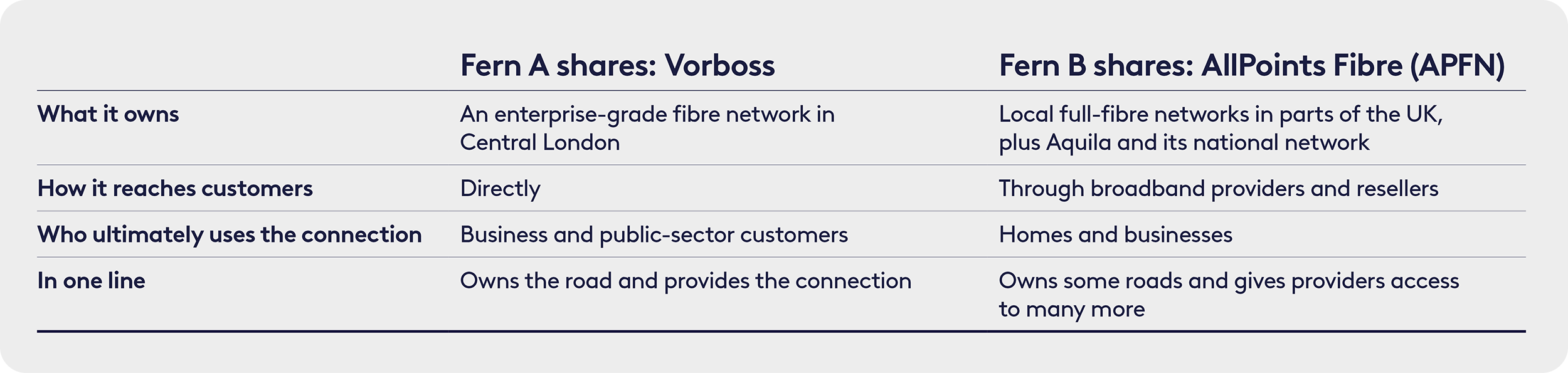
Vorboss and APFN are at different stages. APFN’s wholesale strategy is relatively new and in an earlier part of its journey. It is focused on onboarding wholesale partners and increasing use of the networks available through Aquila. Its place within Fern B gives the strategy greater time and flexibility to develop. Vorboss has completed its network build and has already onboarded customers including Great Ormand Street Hospital, City of London Corporation and Nando’s and remains within the more established and diversified Fern A portfolio.
Same infrastructure, different roles
As the UK continues its move towards full fibre and a more digitally connected economy, that infrastructure has an important role to play though the pace of that development for individual businesses will depend on how the market evolves.
Fern’s two fibre businesses, Vorboss and APFN play different roles and are at different stages of commercial maturity, but both form part of the infrastructure behind the UK’s connectivity. It is the difference in maturity and investment horizon that has led to them being held in separate share classes.
While fibre infrastructure has an important role to play, the success of individual businesses is not guaranteed. Vorboss and APFN face commercial risks, including competition, customer demand and the successful delivery of their respective strategies, and their future performance cannot be guaranteed.
More broadly, investments made within an OITS portfolio are high-risk, long-term investments and your money is at risk Tax treatment depends on individual circumstances and may change in the future. Tax reliefs depends on portfolio companies maintaining their qualifying status.
All information is correct as of October 2026, unless otherwise stated, and provided by Fern Trading Limited.
BR-qualifying investments are not suitable for everyone. This communication does not constitute advice on investments, legal matters, taxation or any other matters. We recommend investors seek professional advice before deciding to invest. Investors should read the product brochure before deciding to invest, this can be found at octopusinvestments.com. Issued by Octopus Investments Limited, which is authorised and regulated by the Financial Conduct Authority. Registered office: 33 Holborn, London EC1N 2HT. Registered in England and Wales No. 03942880. We record telephone calls. October 2026. CAM 016149