










Image: Replacing a blade at one of Fern’s renewable wind sites in France.
From Highland hillsides to Norfolk farms: how Fern’s energy backed businesses help keep the lights on.
Somewhere in the Scottish Highlands, wind turbines are turning. In East Anglia, a power station is running on straw and chicken-farm bedding. In fields across the country, solar panels are quietly generating electricity.
These businesses are owned by Fern Trading Limited (Fern), and most of them are here in the UK. Fern is an unquoted company, and it’s where the Octopus Inheritance Tax Service (OITS) currently invests. OITS is a discretionary managed service, which means Octopus Investments decides where to invest in line with the Service’s mandate, and currently that includes Fern.
Investing in unquoted companies like Fern is high risk, so OITS customers should be prepared to lose some or all of the money they invest.
Fern owns a range of underlying businesses and renewable energy makes up a large part of this. As of 30 June 2025, which is the date of Fern’s latest published report and accounts, it made up over a third of Fern’s Net Asset Value (NAV) and included 195 sites, 192 of which were already operational. 1 In the 2025 financial year, Fern’s energy sites generated enough electricity to power more than one million UK homes.
The way the UK produces energy is changing
Energy has become a much bigger part of the conversation in recent years. Rising bills, volatile global markets and the transition to net zero have put a greater focus on where our energy comes from, and how we build a greener, more resilient system for the future.
Renewable energy has characteristics that may support long-term investment. Some energy sites can operate for several decades, and demand for electricity is ongoing. However, this does not make returns or asset values predictable: performance can be affected by power prices, regulation, financing costs, weather, maintenance requirements and operational performance.
Through its current investment in Fern, OITS investors have exposure to Fern’s portfolio of businesses. Within that portfolio, the majority of the energy sites are already built and operational.
Let’s take a closer look at some of the energy businesses and assets owned by Fern.
Powered by sun and wind
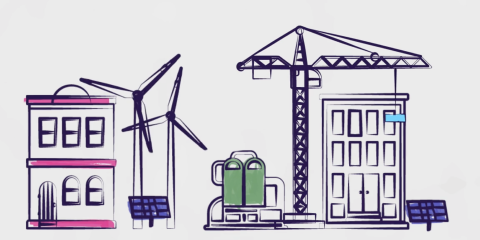
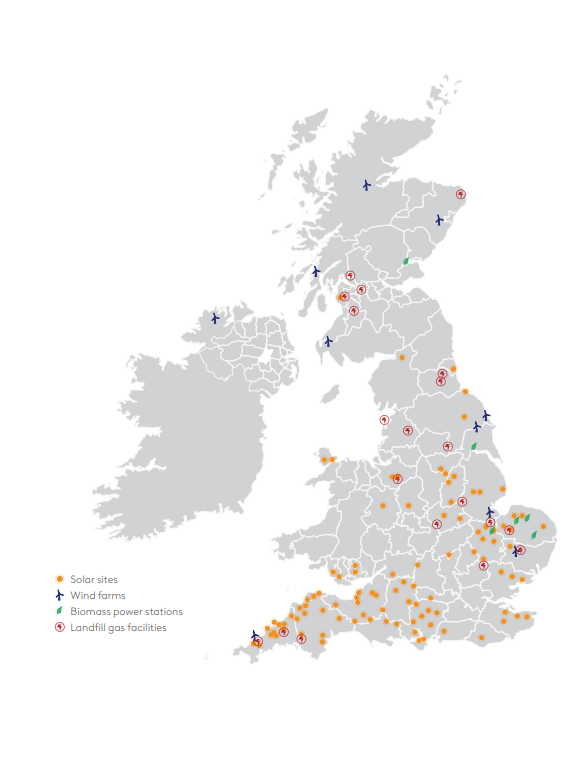
Fern’s wind farms stretch from the Highlands to the Yorkshire coast. They include Beinneun, Cour, Hill of Auquhirie and Fraisthorpe.
Fern also owns a substantial portfolio of large solar farms that generate electricity for sale across the UK, with around 83 sites. Its solar sites produced around 3.2% of the UK’s solar energy, while its wind farms produced around 1.5% of the UK’s onshore wind energy in 2025.
Once a wind or solar farm is built, it doesn’t have to buy its fuel, because the wind and sunshine are free. That doesn’t make the income certain, though. What a site earns still depends on the weather, the price of power and the cost of keeping everything running. There’s a useful balance between the two as well. Solar tends to generate more in summer, while wind often generates more in winter.
But neither can simply be switched on when the weather doesn’t cooperate. That’s where other types of generation come in.
On the ground: Beinneun wind farm
High in the Scottish Highlands sits Beinneun, a 108.8MW wind farm made up of 32 turbines. It is capable of producing around 260,000 MWh of electricity each year.
But its impact extends beyond the electricity it generates.
A community scheme linked to the wind farm supports local social and environmental projects, with 14 receiving funding in the 18 months to November 2025. A scholarship also helps students living within five kilometres of Beinneun attend college or university.
Beinneun is a tangible example of the infrastructure owned within Fern’s renewable energy portfolio. It is an established site, generating electricity and also putting down roots in the communities around it. OITS investors are currently exposed to that portfolio through the shares in Fern held within the Service.
- 32 Turbine
- c.260,000 MWh expected generation each year
- 14 community projects supported over 18 months
Expected generation is not guaranteed and may vary due to weather conditions, site availability and operational performance.
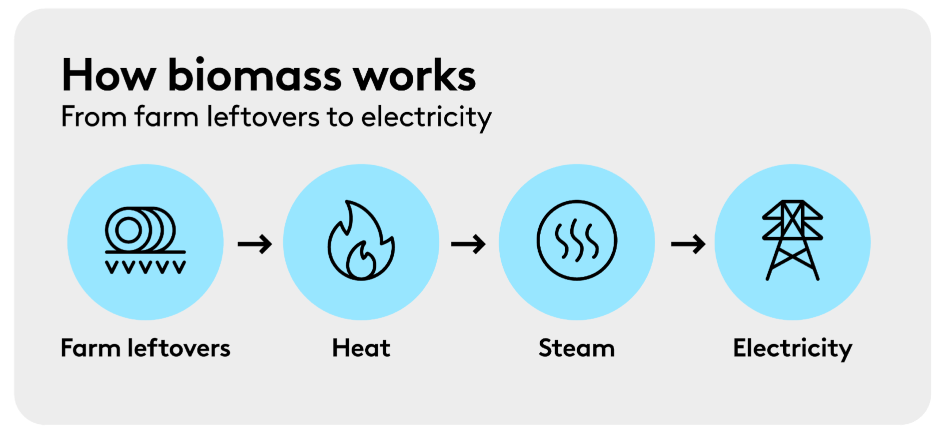
From farm leftovers to electricity
Biomass sounds technical. In practice, the idea is surprisingly simple.
Fern’s biomass power stations use materials such as straw and poultry litter as fuel. These are burnt to produce steam, which drives a generator to produce electricity. Biomass provides electricity that can be generated when it is needed, and isn’t dependent on sunshine or wind conditions, adding another source of generation to Fern’s energy mix.
Inside Westfield power station
In Fife, the 9.8MW Westfield power station uses a mixture including poultry litter and waste wood to generate electricity.
Across Fern’s wider biomass business, significant quantities of agricultural materials are put to use generating electricity, including about 600,000 tonnes of chicken-farm bedding, 430,000 tonnes of straw and 95,000 tonnes of meat and bonemeal in a single year.
There’s a wider benefit too. These businesses support rural jobs and create a productive use for materials from farming.
Why Octopus Investments views energy as the bedrock of Fern’s portfolio
It starts with maturity. Most of Fern’s energy sites are already built, and many have been generating electricity for around a decade. These are established businesses with a history of operating over several years rather than projects that still need to be built.
That matters because of how they earn their money. They sell electricity, and some of that income is agreed in advance through government-backed schemes and long-term contracts. The rest can vary depending on market prices, as well as broader operational risks and market conditions, which means it isn’t predictable. Having some income agreed in advance helps with consistency, but it doesn’t make it guaranteed.
But owning established assets isn’t enough. Ongoing management continues throughout their lives. Experienced teams work to keep sites running well, manage risks and improve performance where possible. They can also renegotiate existing borrowing, invest in upgrades and look for opportunities to extend their useful lives.
Mature businesses. Established operations. Infrastructure providing something people need every day. That’s why we think of energy as the bedrock of Fern.
The challenges
However, established infrastructure doesn’t come without its own challenges. Higher interest rates can reduce how much the businesses are valued at, while changing regulation, maintenance costs and the weather can all affect renewable energy businesses.
Power prices are another important part of the picture. Gas-fired generation still plays an important role in the UK electricity system and can influence wholesale electricity prices. As a result, movements in international gas markets can affect the revenues earned by renewable generators too.
But the energy transition could change that dynamic. The more electricity the UK can generate from clean, home-grown sources, the less reliant the UK can be on gas and the international markets that determine its price.
Fern’s mix of technologies and sites can’t remove these risks. But its size and scale mean its energy portfolio is spread across different sites and types of energy generation, and not dependent on any one asset or source of generation.
The potential to develop existing sites
Looking ahead doesn’t necessarily mean building more and more energy sites. There can also be opportunities to get more from assets Fern already owns and understands.
In France, Fern is repowering two wind sites it has owned since 2019. Repowering sounds complicated, but the principle is simple: replace ageing turbines with newer, more efficient ones.
The new turbines will double the combined generating capacity of the two sites, from 16.8 MW to 33.6 MW. Fern has also secured new 20-year French state-backed agreements for both sites, providing long-term support for the electricity they generate.
It’s an example of how Fern looks to get more from sites it already owns and understands, by adding capacity and extending their working lives. The benefits aren’t guaranteed, though. The work still has to be delivered, and the sites still have to perform in a changing power market. Fern is also looking at the lifespan of existing sites in other ways. For example, it is looking to extend some land agreements well before they expire, giving proven sites the potential to keep operating for longer.
Risks to bear in mind
OITS is a high-risk investment, and your money is at risk. It should be seen as a long-term investment. The Service aims to help investors withdraw money when they need to, but there’s no guarantee a request can always be met straight away or in full.
The tax benefits depend on your individual circumstances, and the rules, and how they’re interpreted, could change in future.
And as we’ve seen, Fern’s energy businesses face risks of their own, including changing power prices, weather, regulation, financing costs and the cost of keeping sites maintained and running well.
Powering what comes next
Octopus Investments feels positive about the energy portfolio and where it’s heading, but that doesn’t mean it’s without risk. With established assets already generating electricity today, Fern’s focus is on continuing to manage them well over the long term, preserving and extending their value where possible and making the most of the opportunities ahead.
If you would like to learn more about OITS, Fern or the renewable energy businesses owned by Fern, please get in touch.
All information is correct as of October 2026, unless otherwise stated, and provided by Octopus Energy Generation
BR-qualifying investments are not suitable for everyone. This communication does not constitute advice on investments, legal matters, taxation or any other matters. We recommend investors seek professional advice before deciding to invest. Investors should read the product brochure before deciding to invest, this can be found at octopusinvestments.com. Personal opinions may change and should not be seen as advice or recommendation. Issued by Octopus Investments Limited, which is authorised and regulated by the Financial Conduct Authority. Registered office: 33 Holborn, London EC1N 2HT. Registered in England and Wales No. 03942880. We record telephone calls. October 2026. CAM016120