










Clients who want to integrate VCTs into estate planning
About this scenario
Venture Capital Trusts (VCTs) can help clients manage income tax on pension withdrawals and support tax efficient estate planning. This scenario shows how advisers can use Venture Capital Trusts and Business Relief to maximise wealth transfer for clients.
We created this tax planning scenario to help advisers develop suitable planning strategies for clients. It does not provide advice on investments, taxation, legal matters, or anything else. As you know, tax-efficient investments aren’t suitable for everyone.
Any recommendation should be based on a holistic review of a client’s financial situation, objectives, and needs. Before recommending an investment, you should also consider the impact of charges related to the product, such as initial fee, ongoing fees, and annual management charges.
Meet Angela, who wants to manage income tax and plan her estate
Angela is 65 and has a sizeable pension pot of £800,000, significantly more than she needs for her own retirement. She had planned to pass this on to her loved ones free from Inheritance tax (IHT), however has heard of the new rules where after 6 April 2027 pensions will be subject to IHT.
She wants to withdraw from her pension to regain some of the IHT efficiency. She has already withdrawn her full tax-free cash allowance, so is looking for planning options that can help her manage income tax on further withdrawals and regain the IHT efficiency on her pension, passing on more to her loved ones.

An estate planning solution
Angela’s adviser assessed her needs, appetite to risk and recommended a strategy that makes use of Venture Capital Trusts and Business Relief, which remain valuable tools for clients like Angela, and could meet all her objectives:
Income tax relief on pension withdrawals:
VCT investments provide 30% relief on the amount invested, which can be offset against income tax such as those on pension withdrawals.
IHT exempt gifts out of income:
VCTs typically pay out regular dividends that when gifted could be exempt from IHT under the gifts out of income rules. Importantly, dividends received from VCTs are free from dividend tax which further increases their tax efficiency.
Angela’s adviser suggests that she withdraw £200,000 from her pension and invests in a VCT, such as Octopus Apollo VCT.
Income tax relief
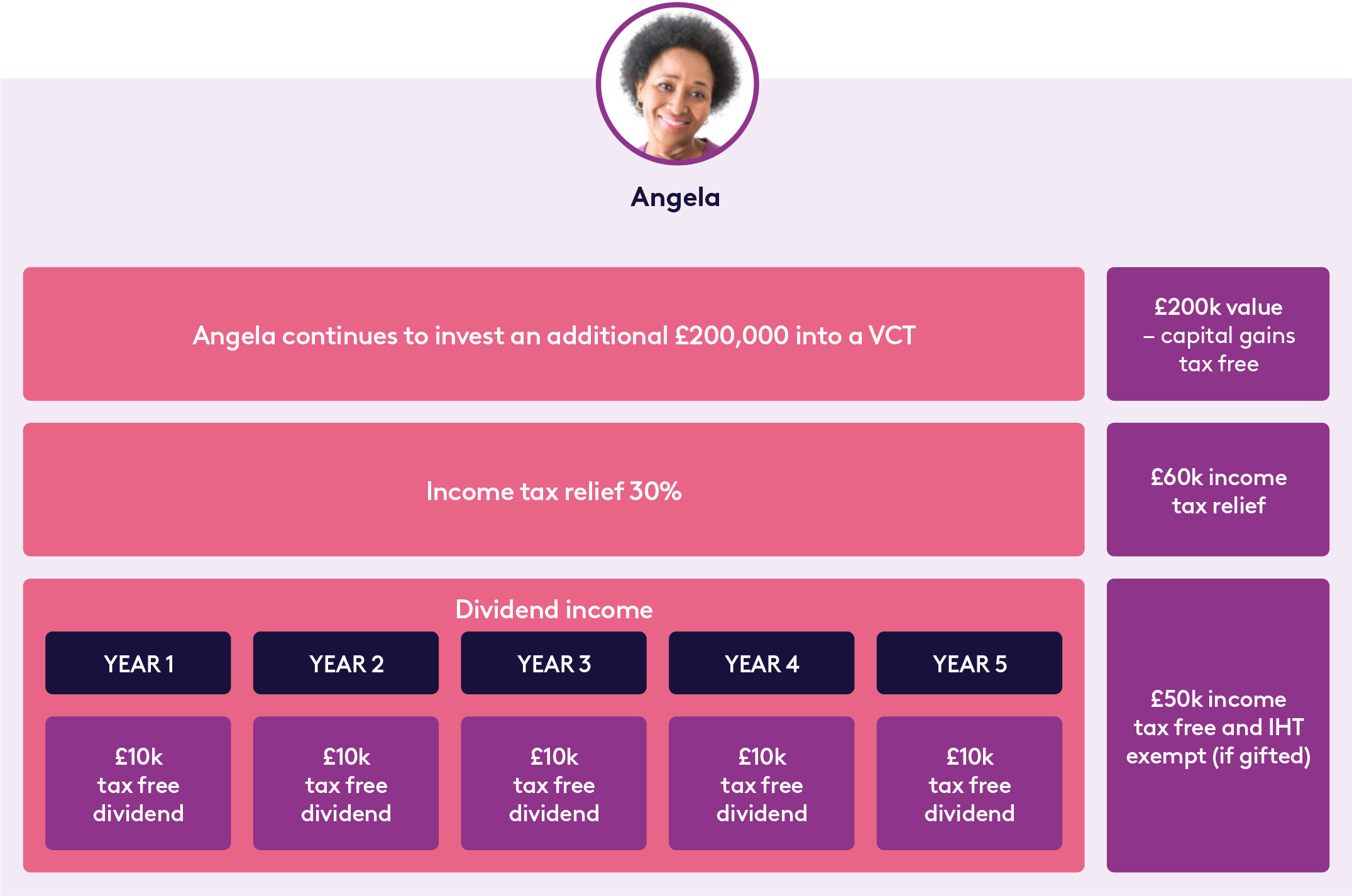
Because she has no tax-free cash left and is a 40% marginal rate taxpayer, she will pay income tax on this withdrawal, leaving her with £120,000 to invest in a VCT. She chooses to top up her VCT investment to the maximum for the tax year, making her total investment £200,000. She does this knowing this should provide her with 30% income tax relief of £60,000 to offset against tax on withdrawal from the pension.
Gift out or surplus income
Over the next five years, the VCT targets a 5% dividend each year, potentially providing her with a total of £50,000 in tax-free income over five years.
This regular, tax-free dividend income can be gifted to her family as “gifts out of income”. As these gifts do not affect her standard of living, they are immediately exempt for inheritance tax purposes and do not use up her nil rate band (NRB). This allows Angela to pass on wealth efficiently, without waiting for the usual sevenyear period that applies to other gifts.
Final IHT planning
Her adviser explains that VCT shares held on death do not qualify for IHT relief. To get full IHT efficiency on the pension withdrawal, after 5 years (which is the minimum period required to keep the initial income tax relief) she could reinvest the funds in an unquoted Business Relief solution such as the Octopus Inheritance Tax Service (OITS).
In 5 years, Angela will be 70 and worries that gifting the asset might leave her exposed to IHT if she dies within seven years. Her adviser clarifies that by investing in an unquoted Business Relief solution, after just two years Angela’s investment should attract 100% relief from IHT of £80,000.
With new rules on pensions, many traditional routes for passing on wealth have become less effective. However, VCTs remain a valuable tool. While VCTs do not remove assets from the estate for IHT purposes, they can provide a flexible, tax-efficient way to generate income that can be gifted. The tax-free capital gains on disposal of VCT shares after the five-year minimum holding period, can provide a tax efficient way to recycle proceeds from matured VCTs into new offers such as Business Relief, unlocking further IHT relief.
How it works in practice:
Notes and assumptions:
- Tax rates and allowances are correct for the tax year 6 April 2025 to 5 April 2026.
- From 6 April 2026, a £2.5 million Individual BR Allowance will be introduced that applies to investments in qualifying assets, unquoted investments (private companies, partnership interests and sole traders) and agricultural property. Amounts up to that allowance are free from inheritance tax. Qualifying investments above this allowance attract relief at 50%. Until 6 April 2026, BR continues to be available at 100% IHT relief on all qualifying investments to an unlimited value.
- VCT income tax relief remains at 30% until 6 April 2026, after which it will reduce to 20%.
- For ease of comparison, we’ve assumed no gains or losses on the assets referenced, no fees paid for financial advice and no product fees have been included, which may apply.
Risks to bear in mind
Capital at risk
BR-qualifying investments and VCTs are high-risk. The value of an investment, and any income from it, can fall as well as rise. Investors may not get back the full amount they invest.
Tax treatment may change
Tax treatment depends on individual circumstances and tax rules could change in the future.
The investment may be volatile and difficult to sell
The shares of unquoted companies could fall or rise in value more than shares listed on the main market of the London Stock Exchange. They may also be harder to sell.
BR is assessed on a case-by-case basis
Tax relief depends on portfolio companies maintaining their qualifying status.
More tax planning scenarios?
Estate planning for clients who’ve sold a business in the last three years
Alan recently sold his business and wants to leave the proceeds to his daughters free of inheritance tax.

Estate planning for clients who want to retain access to capital
Carol is aged 86 with a large estate. She's worried about unexpected care costs and is reluctant to gift.

Estate planning for clients who worry it’s too late
Harold worries that in his 90s it's too late to plan for inheritance tax.

Estate planning for clients who want to settle assets into trust
Louise is worried that her child's marriage will end in divorce, and wants control over what will happen to her assets.

Estate planning for clients who want an inheritance tax-efficient ISA
Peter has a large ISA pot that's subject to inheritance tax. He wants to plan for inheritance tax but keep the benefits of the ISA wrapper.