






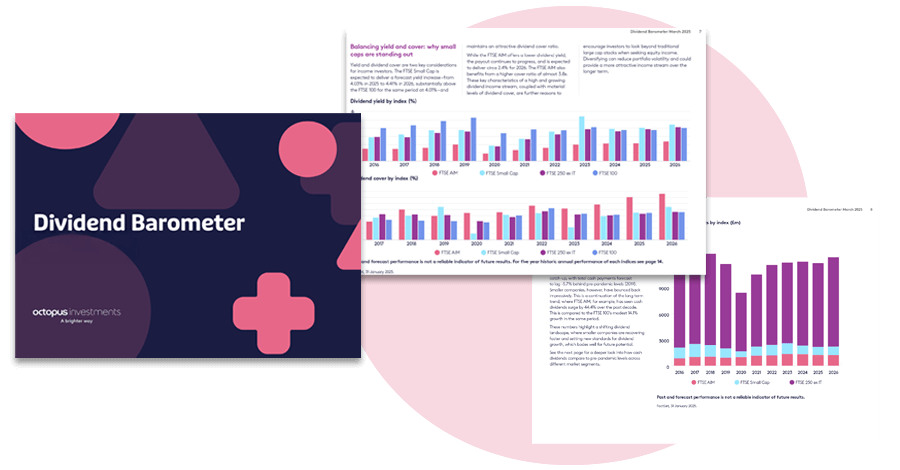





Octopus Investments today releases its bi-annual Dividend Barometer (the Barometer), which champions the lesser-known dividend credentials of small and mid-cap income-generating stocks.
Over the six months from March to October covered in this Barometer, there’s been a period of dramatic events around the world with stock market volatility in response to Donald Trump’s tariff announcements.
As trade negotiations have progressed, markets recovered. During this recovery period, UK smaller-cap stocks outperformed their larger peers, with the FTSE SmallCap Index, excluding investment trusts, up 15% on a total-return basis in the period, and the FTSE AIM Index up 16.6%. These gains compare favourably with the 12% rise in the FTSE 100 over the same period.
Whilst this outperformance could be as a result of a more domestically-driven revenue base, the Barometer argues it could also be due to the once-in-a-cycle low valuation levels at which many UK smaller companies have been trading. The undervaluation is despite the strong earnings growth potential of UK small caps.
According to current consensus estimates, the FTSE AIM Index should deliver compound annual earnings growth of 23.3% for the two years to December 2026. This is a higher growth rate than that of the Nasdaq Composite Index in the US. But while the Nasdaq trades at an EV/EBITDA multiple of 17.3x, the FTSE AIM Index trades at a multiple of just 6.2x. Moreover, the FTSE Small Cap (ex Investments Trusts) trades on only 5.1x, whilst offering the prospect for mid-teens earnings growth.
Meanwhile, both the FTSE SmallCap (ex investment trusts) and the FTSE 250 continue to offer a higher dividend yield than the FTSE 100, which has declined over recent years as large-cap companies looked to rebuild dividend cover after the Covid pandemic.
The ongoing valuation gap is one reason for the uptick in corporate acquisitions in recent months. From 1 January 2024 to 1 October 2025, over 80 bids were made for UK-listed companies with a market cap of more than £100m.The average bid premium was over 40% greater than the undisturbed share price – highlighting the pent-up value on offer in the small and mid-cap indices.
One side-effect of this activity is that overall, UK dividend payments are expected to drop in 2025. Yet, given the solid levels of dividend growth expected across the UK quoted markets, the overall level of payouts should recover to deliver double-digit growth once again next year.
Moreover, despite the 2025 decline, smaller companies’ long-term growth remains impressive.
Over the past 10 years, for example, overall AIM payouts have risen by almost 30%. For the same period, payments from the FTSE 100 are up by only around 9%.
One particularly compelling feature of smaller-cap indices is their lack of concentration when it comes to dividends. In the FTSE 100, the top 10 dividend payers account for more than half (53%) of the total dividend payout, compared to 38% for the FTSE AIM, 34% for the FTSE SmallCap (ex investment trusts) and 28% for the FTSE 250. This means that income from smaller-cap stocks rests on more individual companies – making it less exposed to any individual dividend cut or cancellation when companies run into difficulties.
There is also scope for reduced sector concentration for investors willing to look more broadly across the markets. In most UK indices, the Financials sector accounts for the lion’s share of dividends – including almost half of those paid out by FTSE 100 companies. The Barometer suggests that this reminds investors that the index serves as a useful diversifier for income-focused portfolios.
The Barometer has also revealed this edition’s ‘dividend diamonds’, two UK-listed stocks that have strong long-term growth dynamics and attractive dividends:
- XPS: a leading pension consulting and administration business that has been rewarding investors with an attractive and growing dividend yield of around 4% for the current year.
- Young & Co’s Brewery: the owner and operator of pubs and hotels, predominantly in London and the South East of England, which is expected to deliver shareholders a yield in excess of 3% for the current year.
Chris McVey, Deputy Head of Quoted Companies at Octopus Investments, comments:
“The last six months have seen steady performance for many smaller-cap stocks. But this performance hasn’t changed their long-term undervaluation compared with their larger-cap and global peers. At the same time, the yields on both the FTSE 250 and the FTSE SmallCap (ex investment trusts) indices remain above the FTSE 100.
“It’s with this in mind that we believe it’s an anomaly that these companies are continuing to fly under the radar for traditional income investors. Investors should take advantage of this now as UK smaller-cap stocks can offer them a compelling opportunity in terms of both absolute and relative value, as well as income, benefitting from attractive and growing dividend streams.”