











Estate planning for clients who have a power of attorney in place
What to do for clients who have a power of attorney in place?
Estate planning options can be limited where a power of attorney is in place. Any decisions made by the attorney will need to be in the best interest of the donor on whose behalf they’re acting.
Planning will of course depend on the donor’s circumstances and wishes but making lifetime gifts or settling assets into trust is typically difficult.
Investments that qualify for Business Relief (BR) are a potential solution for donors who have expressed wishes to plan for their estate. That’s because a BR qualifying investment stays in the donor’s name.
About this planning scenario
We created this tax planning scenario to help advisers develop suitable planning strategies for clients. It does not provide advice on investments, taxation, legal matters, or anything else.
Tax-efficient investments aren’t suitable for everyone. Any recommendation should be based on a holistic review of a client’s financial situation, objectives and needs.
Advisers should also consider the impact of
charges related to the product, such as initial fee, ongoing fees, and annual management charges.
Meet Barbara and Malcolm
Meet Barbara and Malcolm

Meet Barbara, who has lost capacity
Barbara is 88 and widowed. She has lost capacity, and a lasting power of attorney is in place for her financial affairs, with her grandson acting as attorney.
Barbara’s grandson wants to help her stay in her home, where she receives at-home care. The cost of this care is being met by income from Barbara’s pension.
He is also mindful of inheritance tax (IHT), and the fact that Malcolm has expressed the desire to leave as much of her estate as she can to her great-grandchildren.
Although Barbara’s adviser explains that their ongoing needs are expected to be met from her income, her attorney is reluctant to make gifts from her estate in case she needs access to the funds in the future.
A tax planning solution
Barbara’s attorney needs to ensure that any
investment decisions are made in his grandmother’s
best interests and won’t disadvantage her, for example,
by making her money inaccessible.
The adviser assesses Barbara’s objectives, appetite
for risk and capacity for loss and suggests moving
£300,000 of her existing investments into an
investment that qualifies for BR.
He explains that if a BR-qualifying investment is held
for two years and at the time of death, it should offer
relief from inheritance tax. Another advantage is
that the investment will be made in Barbara’s name,
meaning that she will retain ownership of her wealth.
BR-qualifying portfolios invest in the shares of one or
more unquoted or AIM-listed companies. They are higher
risk investments than her existing investments, and the
tax relief is designed to provide some compensation to
investors for taking additional risk.
Unlike estate planning strategies that rely on life
assurance, there are no underwriting or complicated
medical forms to complete – the application process is
straightforward. Withdrawals can be requested at any
time, for example if Barbara requires additional funds
for care home fees, however they will be facilitated by
the sale of shares and so cannot be guaranteed.
The adviser explains the risks to the attorney
Making a BR-qualifying investment would put Barbara’s capital at risk. The value of their investment, and any income from it, could fall or rise, and she may not get back the full amount she put in.
BR-qualifying investments have to be made into unquoted or AIM-listed shares. The shares of unquoted companies and those quoted on the AIM can fall or rise by more than shares quoted on the main market of the London Stock Exchange. They may also be harder to sell.
Barbara’s attorney is made aware that requests to withdraw might not always be able to be met.
Her adviser also explains that HMRC assesses BR on a case-by-case basis when an estate makes a claim. The ability to claim the relief would depend on the company or companies Barbara invests in qualifying at the time the claim is made. Tax treatment would also depend on their personal circumstances, and tax rules could change in future.
How it works
How it works in practice
Let’s see how it might look if Barbara was to sell £300,000 of her existing share portfolio and invest in the Octopus Inheritance Tax Service, a service that invests in the shares of one or more unquoted companies expected to qualify for BR.
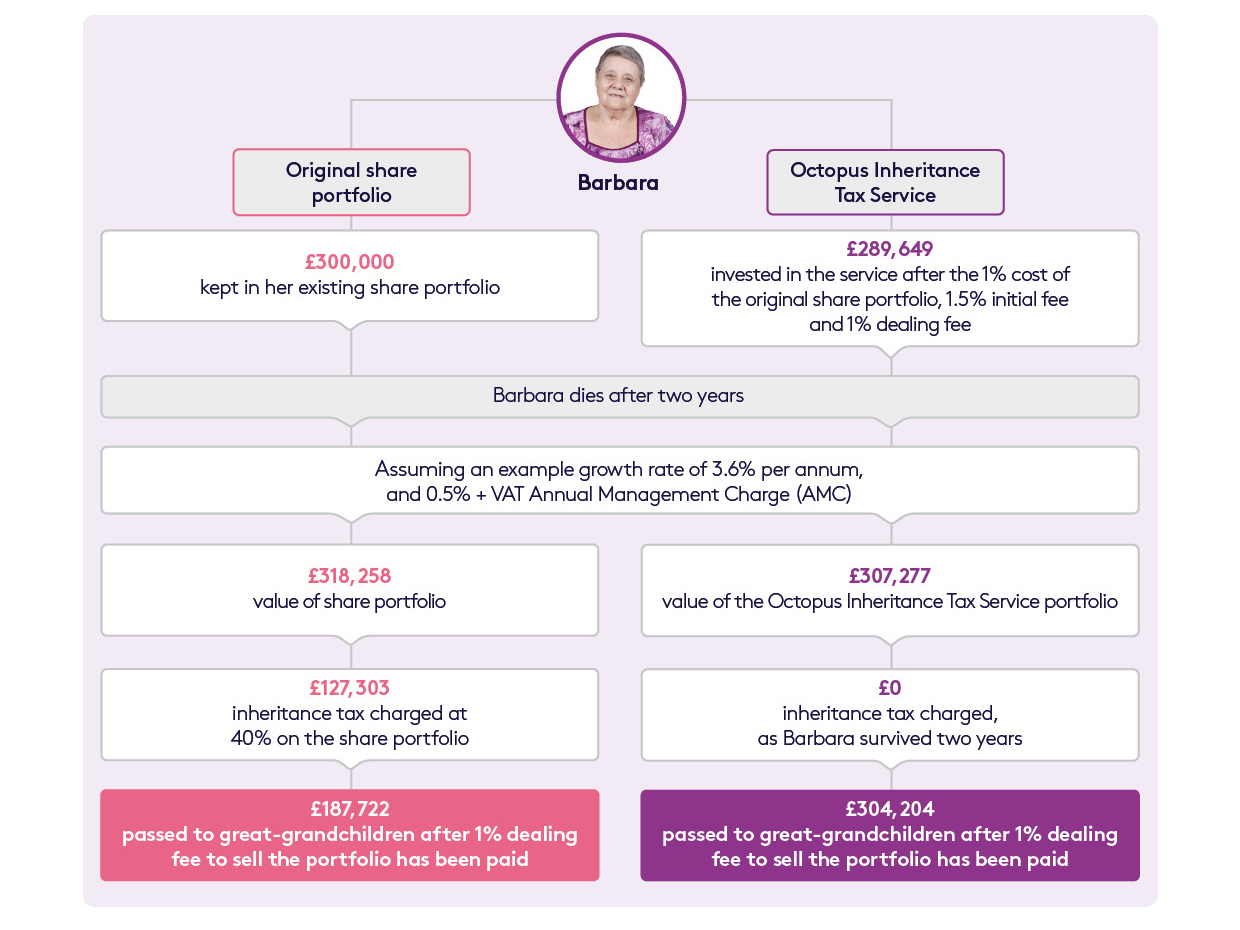
Note: Tax legislation, rates and allowances are correct at time of publishing for the tax year 2025-26. This example is for illustrative purposes only and each investor’s own tax situation may be different. For ease of comparison, we’ve assumed identical charging structures, an annual growth rate of 3.6%, and that annual management charges are calculated and paid based on the investment value at the end of each annual period. The dealing fee on shares sold to pay the AMC has not been factored. The risk profile of each portfolio, charging structure, and any growth or losses is likely to differ. This example does not include any charges paid for financial advice. In practice the Octopus Inheritance Tax Service has an initial charge of 1.5%, a deferred AMC of up to 0.5% VAT and a dealing fee of 1%. AMC is calculated daily and paid pro-rata, contingent on performance, when shares are sold. This example assumes that the investments will be held until death and the nil-rate band is offset against other assets.
Get in touch with your local IHT expert to discuss this scenario
Please note
- This example is for illustrative purposes only and each investor’s own tax situation may be different.
- For ease of comparison, we’ve assumed identical charging structures, an annual growth rate of 3.6%, and that annual management charges are calculated annually.
- The risk profile of each portfolio, charging structure, and any growth or losses is likely to differ.
- This example does not include any charges paid for financial advice.
- The Octopus Inheritance Tax Service has an initial charge of 1.5%, a deferred AMC of 0.5% + VAT and a dealing fee of 1% for investments and withdrawals. AMC is calculated daily.
- This example assumes that the investment will be held until death, the nil-rate band is offset against other assets, and the Octopus Inheritance Tax Service investment qualifies for BR.
Find out more about how the Octopus Inheritance Tax Service could help clients like Barbara
Other Scenarios
More tax planning scenarios?

Estate planning for clients who’ve sold a business in the last three years
Alan recently sold his business and wants to leave the proceeds to his daughters free of inheritance tax.

Estate planning for clients who want to retain access to capital
Carol is aged 86 with a large estate. She's worried about unexpected care costs and is reluctant to gift.

Estate planning for clients who worry it’s too late
Harold worries that in his 90s it's too late to plan for inheritance tax.

Estate planning for clients who want to settle assets into trust
Louise is worried that her child's marriage will end in divorce, and wants control over what will happen to her assets.

Estate planning for clients who want an inheritance tax-efficient ISA
Peter has a large ISA pot that's subject to inheritance tax. He wants to plan for inheritance tax but keep the benefits of the ISA wrapper.